Culture determines whether your organization adapts in time or not
Most organizations invest in strategy, technology, AI-tools, and structure. Then wonder why nothing actually changes.
The missing piece is almost always culture: how people think, collaborate, make decisions, and respond when things get uncertain.
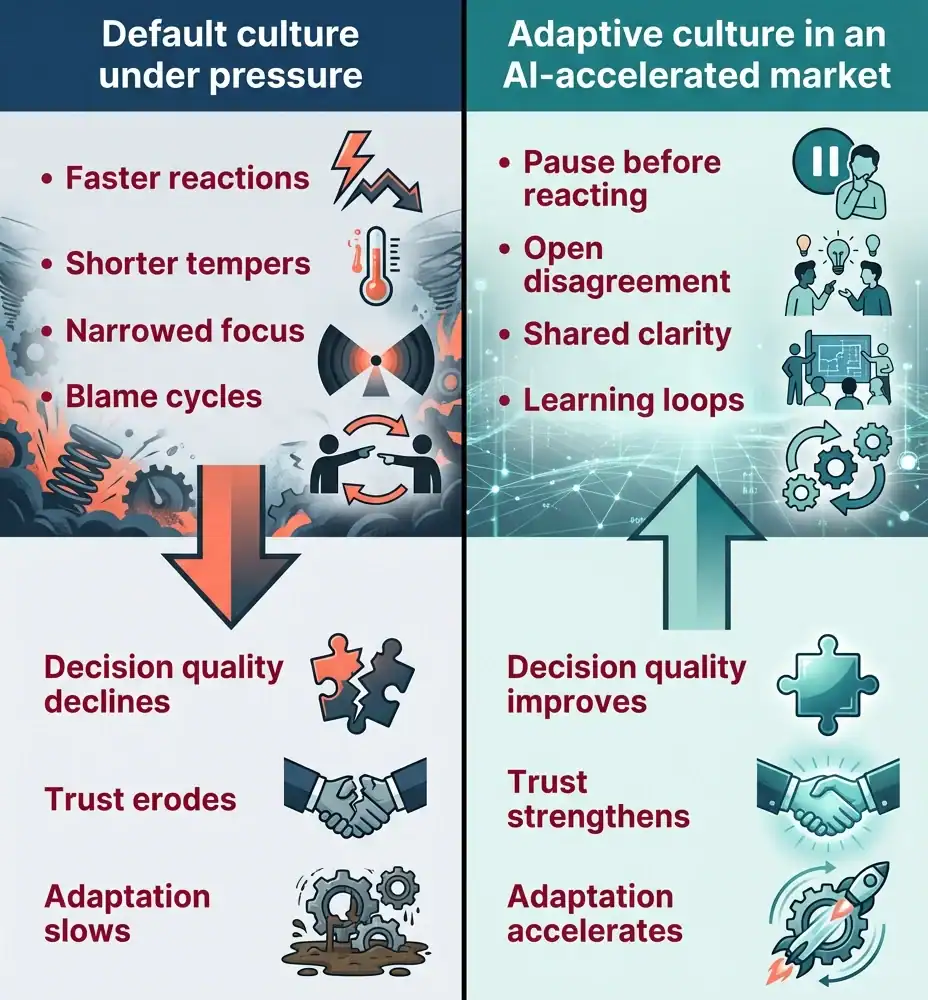
In an AI-accelerated world, culture is the difference between an organization that adapts and one that resists until it’s too late.
HOW POSITIVE IS YOUR CULTURE?
Positive cultures consistently outperform their competitors. Higher productivity, better performance, increased innovation, greater collaboration. Not because people are happier (though they are), but because positive cultures are inherently more adaptive.
A positive culture is built on four foundations:
- Positive awareness: people notice what works, not just what’s broken.
- Connection and collaboration: trust is high, so everyone feels safe to contribute, improve and decide under uncertainty.
- Shared meaningful purpose: people know why their work matters.
- Learning and autonomy: mistakes are information, not verdicts. Adaptability follows learning. Ownership and accountability follow professional autonomy.
Where does your culture stand on these four? That’s where culture development starts.
Our Positive Culture Academy gives leaders, managers, and HR professionals the practical tools to develop a more positive, motivated, collaborative, and adaptive organizational culture.
Explore the Positive Culture Academy →
HOW FUTURE-FIT IS YOUR CULTURE?
A positive culture prepares your organization for change from within. But culture alone won’t tell you what’s coming from outside.
Future-fit organizations combine cultural adaptability with strategic foresight. They read weak signals early. They question assumptions before those assumptions break them. They run structured experiments instead of waiting for certainty.
Ask yourself one honest question: will your organization still be doing well in 7 years, if nothing changes?
If the answer is uncertain, that’s worth paying attention to now.
Our Strategic Foresight and Futures Community (FFC) helps organizations develop the foresight habits and tools to anticipate change, build scenarios, and stress-test strategy against multiple possible futures.
Learn About Strategic Foresight →
CULTURE AND FORESIGHT IN YOUR ORGANIZATION
Online programs are one way to build these capabilities. For leadership teams that want to go deeper, we bring this work directly into your organization.
In-Company Positive Culture Program
We work with your leadership team and HR to develop a more positive, adaptive culture, customized to your organization’s specific challenges and starting point. Based on the Positive Culture Academy methodology, applied to your context.
This is done-with-you work, not a standard training. We help you diagnose where your culture is today, identify the highest-leverage shifts, and build practical habits that stick.
Contact us to discuss →
In-Company Strategic Foresight Program
We bring strategic foresight methodology directly into your leadership team, customized to your sector and your strategic questions. Scenario thinking, assumption stress-testing, and signal scanning, applied to your real decisions.
Based on the FFC methodology, shaped around your organization.
Contact us to discuss →
NOT SURE WHERE TO START?
Download our free Future-Fit Diagnostic. A short tool that helps you assess where your organization is most exposed and where culture or foresight work would have the most impact.
You’ll get it when you subscribe to our Future-Fit Newsletter, with weekly insights on adaptive strategy, culture, and decision-making for leaders.
FURTHER READING
“Developing a Positive Culture where People and Performance Thrive” is Marcella’s comprehensive book on culture change with practical frameworks, real case studies, and step-by-step implementation guidance.
“One of the BEST pieces on culture change. I wish I had read this 35 years ago!”
Michael Wolf, Principal Consultant CulturLogix